

Agentic AI is finally closing a gap that's quietly slowed down every data-driven organization, the distance between having a question and getting a trustworthy answer, without needing to know SQL.
For decades, getting an answer out of a company's database meant finding someone who knew SQL, filing a request, waiting for an analyst, and hoping the resulting query matched what you actually meant to ask. Large language models promised to fix this: if a model can read a schema and understand English, why not let anyone type a question and get SQL back? That's the idea behind Text-to-SQL. But as thousands of teams have found while shipping it into production, a single model call converting words into a query isn't enough for real business use. That's where agentic AI comes in, not as a buzzword, but as an architecture that turns a fragile party trick into a dependable data assistant.
This blog explains what Text-to-SQL is, why the naive version breaks down, and how an agentic workflow makes it genuinely reliable.
What is Text-to-SQL?
Text-to-SQL is the task of translating a natural-language question, say “how many new customers did we add in June?”, into a syntactically correct SQL query a database can run. A working system needs three ingredients:
• A model that maps everyday phrases (“top five,” “last quarter”) onto SQL clauses like ORDER BY, LIMIT, or date filters
• Schema awareness- knowing which tables and columns exist and how they relate
• An execution environment where the generated query actually runs against the database
Academic benchmarks like Spider and WikiSQL treat this as single-shot translation, which works on clean, small datasets but breaks down fast on the messy, sprawling schemas where enterprise value actually lives.
What is Agentic AI?
Agentic AI describes systems built from one or more autonomous agents that plan, act, observe results, and adjust rather than answering once and stopping. An agentic system can:
• Break a large task into sub-tasks and decide the order to tackle them
• Call external tools like databases, search, APIs and read back the results
• Evaluate its own output and retry or self-correct when it's wrong
• Maintain state across steps so context isn't lost mid-task
Frameworks like LangGraph model this as a graph of agents and tools with conditional routing for example, sending a failed query to a “fix it” agent instead of straight to the user. That's exactly the structure a production Text-to-SQL system needs.
Why One-Shot Text-to-SQL Falls Short
Asking a single LLM call to go directly from question to correct, executable SQL runs into real problems the moment you leave toy datasets behind:
• Schema overload: Schema overload hundreds of tables and thousands of columns blow past context limits and increase hallucinated table or column names
• Ambiguous language: “Active customer” or “this quarter” can mean different things by region or fiscal calendar, and a one-shot model can't check which applies
• No error recovery: A typo or invalid column reference just fails- there's no mechanism to read the database error and retry
• No validation before execution: Nothing checks whether a query is safe, scoped correctly, or sensible before it runs against production
• No multi-step reasoning: Real questions often need filter → join → aggregate → filter again, which benefits from planning rather than one-shot generation
One-shot Text-to-SQL treats query generation as a translation problem. In practice, it's a reasoning and verification problem exactly what agentic architectures are built to solve.
Agentic Text-to-SQL Workflow
A production-grade agentic Text-to-SQL system splits the work across several cooperating agents, coordinated by an orchestrator:
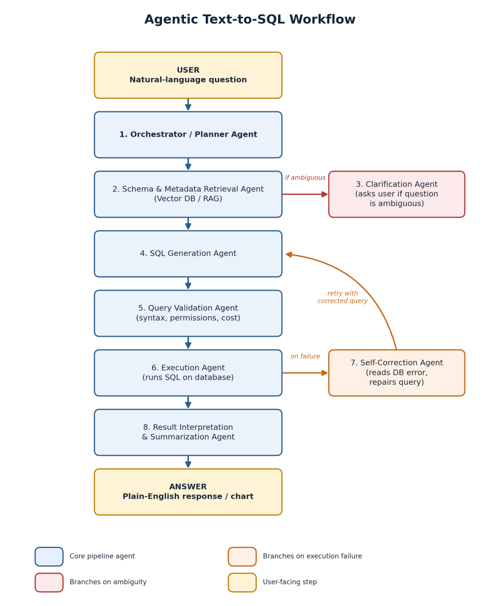
Figure: A typical agentic Text-to-SQL workflow with a self-correction loop
1. Orchestrator / Planner Agent: Receives the user's question, decides what needs to happen next, and routes work to the right specialist agents.
2. Schema & Metadata Retrieval Agent: Uses vector search (RAG) over table and column descriptions to pull in only the schema fragments relevant to this question, rather than the whole database.
3. Clarification Agent: If the question is genuinely ambiguous (“recent orders” with no defined window), asks a targeted follow-up instead of guessing.
4. SQL Generation Agent: Writes a first-draft query using the narrowed schema context and the user's intent.
5. Query Validation Agent: Statically checks the draft for syntax errors, dialect compatibility, permission scope, and cost or performance issues before anything touches the live database.
6. Execution Agent: Runs the validated query (often against a read-only replica) and captures results or the error message.
7. Self-Correction Agent: On failure, reads the actual database error, diagnoses the cause, and feeds a corrected instruction back to the SQL Generation Agent closing the loop in the diagram.
8. Result Interpretation & Summarization Agent: Once a query succeeds, turns raw rows into a plain-English answer, a chart, or both.
Walkthrough: A Finance Director Asks a Question
Here's how the eight agents above handle a real request: “Show me our top 10 suppliers by total payments in Q2, and flag any with payments over $50,000 that don't have a matching purchase order.”
• Plan: The Orchestrator recognizes this as a two-part analytical question, a ranking plus an exception check, and routes it to schema retrieval first.
• Retrieve: The Retrieval Agent pulls only the supplier, payments, and purchase_order tables (and the keys linking them), ignoring the other ~200 tables in the warehouse.
• Clarify (skipped): The question is specific enough (defined quarter, defined dollar threshold) that the Clarification Agent has nothing to ask it passes straight through.
• Generate: The SQL Generation Agent drafts a query joining payments to suppliers, aggregating by supplier for Q2, and left joining to purchase orders to surface unmatched payments over $50,000.
• Validate: The Validation Agent checks the draft against the real schema and confirms the join keys and date filters are correct before anything runs.
• Execute (attempt 1): On the first run, the database rejects the query, the payments table uses po_id, not purchase_order_id.
• Self-correct: The Self-Correction Agent reads that exact error, fixes the column name, and sends the corrected query back for another pass.
• Execute (attempt 2): The corrected query runs cleanly against the read-only replica and returns 10 supplier rows plus 3 flagged payments.
• Summarize: The Summarization Agent returns a ranked supplier list, calls out the 3 flagged payments by name and amount, and offers a follow-up chart all inside the same chat turn the Finance Director started with.
This is the difference a multi-agent design makes visible: a single model call would have either failed silently on the wrong column name or, worse, guessed a plausible-looking join and returned a confidently wrong number.
What Makes It Agentic?
It's worth being precise about what separates this from “just chaining a few prompts together.” A workflow earns the label agentic when it has:
• Autonomy in decision-making: The orchestrator decides which agents to call and in what order based on the situation, not a fixed script.
• Tool use: Agents call external systems the vector database, the SQL database and incorporate real results into their next decision.
• Feedback loops and self-correction: When something fails, the system observes it and changes its next action instead of repeating the same mistake.
• State and memory across steps: The system remembers the original question, retrieved schema, and prior failed attempts as it moves through the pipeline.
• Goal-directed behavior: Every agent's output is judged against whether it moves toward a correct, executable answer, not whether it looks plausible in isolation.
Remove any one of these and the system reverts to a pipeline of independent prompts. Keep all of them, and it behaves less like a translator and more like a careful analyst working through a problem.
Guarding Against Hallucination
Reliability is the whole point of this architecture, so it's worth being explicit about how it keeps agents from inventing tables, columns, or joins that don't exist:
• Schema-grounded generation: The SQL Generation Agent only ever sees the schema fragments the Retrieval Agent actually pulled, so it has nothing invented to reach for.
• Static validation before execution: The Validation Agent checks table names, column names, and join paths against the real schema before anything touches the database, catching hallucinations before execution.
• Execution-grounded correction: When a query fails, the Self-Correction Agent works from the database's actual error message, not a guess, so fixes are grounded in fact rather than another hallucination.
• Guardrails on top: Read-only execution, row and cost limits, and audit logging catch anything that slips through the first three layers.
Democratizing Data Access
When a marketing lead, a support manager, or a founder can type a question in plain English and trust the answer, several things change at once:
• Analysts are freed from repetitive requests: Routine “how many / what percent / top N” questions no longer sit in a data team's queue, freeing analysts for genuinely complex modeling work.
• Decisions move at the speed of the question: A question asked in a meeting can be answered in that same meeting instead of a follow-up email three days later.
• SQL literacy stops being a gatekeeper: Domain experts who understand the business best but have never written a JOIN get a direct line to the underlying data.
• Smaller teams get analyst-level capability: Startups and small teams that could never justify a dedicated analyst hire can still get accurate, ad hoc answers.
That's the real payoff, not a clever engineering pattern, but a shorter distance between having a question and getting a trustworthy answer.
When NOT to Use Agentic Text-to-SQL
This architecture earns its complexity on ad hoc, exploratory questions. It's the wrong tool in a few common situations:
• Recurring, well-defined reports: If the same 10 metrics get pulled every Monday, a scheduled dashboard is faster, cheaper, and more auditable than routing through several agents each time.
• Sub-second latency needs: Multi-agent retry loops add latency that a single cached dashboard query doesn't have.
• Highly regulated, fixed-format reporting: Filings or compliance reports where the query logic must be locked and versioned are better served by a maintained, reviewed SQL pipeline.
• Very small or simple schemas: A handful of tables rarely need retrieval, planning, or self-correction, a single well-tested query template does the job.
In short: reach for this on the questions you didn't see coming and keep dashboards for the ones you did.
Benefits and Challenges
Benefits
• Higher accuracy on complex, multi-step, and ambiguous questions compared to single-shot generation.
• Built-in error recovery, so temporary mistakes are fixed automatically instead of dead-ending on the user.
• Better scalability to large, real-world schemas, since retrieval narrows the relevant tables instead of loading everything at once.
• Safer operation, since a dedicated validation step catches unsafe or out-of-scope queries before execution.
• Broader accessibility for non-technical users, shortening the path from question to decision.
• Measurable business impact: Teams report lower ad hoc ticket volume for the data team, faster turnaround from question to answer, and higher self- service adoption among non-technical staff.
Challenges
• Latency and cost: Routing a question through several agents and possible retries is inherently slower and more expensive than a single model call.
• Scaling to very large or non-relational schemas: Retrieval and reasoning can still struggle once a database grows far beyond a few hundred tables.
• Complex query patterns: Deeply nested subqueries and unusual SQL dialect features can still trip up even a well-orchestrated pipeline.
• Governance and security: Agents that generate and execute arbitrary queries need careful permission, read-only boundaries, and audit logging so democratized access doesn't become uncontrolled access.
• Trust and explainability: Users need visibility into the query that actually ran and the assumptions the agents made, not just a final number.
Conclusion
Text-to-SQL answered an appealing question; can a model turn English into SQL? On its own, it never solved the harder problem of doing that reliably against messy, real-world databases. Agentic AI reframes the task correctly: plan, retrieve, generate, validate, execute, self-correct, the way a careful analyst works through a problem.
Three things to take away:
• The multi-agent structure exists to solve reliability, not to add complexity for its own sake.
• Validation and self-correction are what make it safe to hand to non-technical users.
• It's a tool for ad hoc, exploratory questions, pair it with dashboards for the reporting you already know you need.
References
1. Towards Dev : Building Production-Grade Multi-Agent Text2SQL Chatbots in 2026
2. PuppyGraph : Agentic Text-to-SQL: A Detailed Guide
3. Emergent Mind : Agentic Text-to-SQL Systems
4. Towards AI : Agentic AI Project: Multi-Agent Text2SQL Chatbot for Ecommerce Database using LangGraph
5. Veeam : Multi-Agent AI for SQL Databases
6. Emergent Mind : AGENTIQL: Multi-Agent Text-to-SQL Framework
7. arXiv : MARS-SQL: A Multi-Agent Reinforcement Learning Framework for Text-to-SQL