

Picture a procurement team hit by a sudden supply chain problem. With a regular generative AI assistant, the AI looks at the data, sums up the risks and drafts an email that a manager can send to other vendors. With agentic AI, it goes a step further. It checks the available vendors, negotiates the price and places the purchase order by itself, so nothing gets delayed.
That jumps from suggesting to actually doing is what makes agentic AI so useful. It stops being a brainstorming helper and starts working like a digital employee. But it also raises a question every business leader will ask sooner or later: if an AI agent can act for my company, how do I know it is acting safely, fairly and within the rules?
More and more companies are moving from simple copilots to setups where several agents work together. At that point, auditing and governance can’t be something you think about later. They are what make an AI agent safe enough to trust with real work.
Why Agentic AI Needs a New Kind of Governance
Most AI governance so far has been about data privacy, bias and hallucinations, which is when an AI confidently says something that is wrong. With a normal chatbot, that is usually not a big deal. You get a bad piece of text, and a person catches it before it goes anywhere.
An agent is different. If it gets something wrong, it might delete a production database, send a non-compliant email to a client, or make a bad financial trade. Agents are connected to tools, APIs and company systems, so one mistake can do a lot more damage.
So written AI guidelines on their own are not enough. Companies need guardrails that work while the agent is running.
Enterprise Governance Rule #1
An agent can carry out an action, but the responsibility always stays with the company and the people who gave it that authority.
Four Things Every Company Needs to Put in Place
There is no single switch that makes an agent safe. You need a few layers working together. Here are the four that matter most.
1. Give each agent only the access it needs (RBAC for agents)
You wouldn’t give every employee access to every system in the company, and the same goes for an AI agent. It should get the least access it needs to do its job. A customer service agent that handles refunds needs to write to the billing system. It has no business touching the HR database.
- The Fix: Put every tool behind a strict API gateway, so each time the agent uses a tool, it has to show a token that belongs to its specific role.
- The Fix: Log every action. That means the original request, the agent’s reasoning along the way, the tools it chose to use, the data it pulled up and the final result. Lock the logs so nobody can edit them later. Then you can replay what happened, step by step.
- The Fix: Let the agent handle low-risk work on its own, like sorting incoming IT tickets. For high-risk actions, such as a wire transfer above $10,000 or sending an outside legal document, make it stop and ask a supervisor to click Approve or Reject before it goes on.
- The Fix: Set firm limits. If an agent starts looping, uses up too much of its compute budget, or tries to reach an API it shouldn’t, an automatic kill switch should shut it down cleanly and alert a human engineer.
2. Keep a record of everything the agent does
In a regulated industry, nobody accepts “the AI just decided” as an answer. If an agent approves a loan or changes a delivery route, auditors will want to know exactly why.
3. Decide when a human must step in (HITL vs. HOTL)
Not everything should run on autopilot. Your rules should say which actions need a person to approve them first (human-in-the-loop) and which only need a person keeping an eye on things (human-on-the-loop).
4. Set limits and keep a kill switch
Agents chase their goal, and sometimes they try to use a tool in a way nobody expected.
Real Examples of Governance at Work
Two examples from different industries show what this looks like in real life.
Example 1: The Supply Chain Agent That Ran Away
The Scenario: A manufacturing company sets up an AI agent to watch its warehouse stock. When stock falls below a set level, the agent is allowed to reorder from a vendor through the vendor’s API.
The Risk: A data formatting error in the vendor’s system makes it look like the warehouse has zero stock. The agent reacts right away and orders $500,000 worth of materials. That badly hurts the company’s cash flow.
The Governance Solution: The company adds a spending limit. The agent can order up to $10,000 of stock on its own. Anything above that stops the workflow and sends a message on Teams or Slack to the Procurement Manager: “Agent is trying to issue a PO for $500,000. Approve / Deny?”
Example 2: Financial Compliance and Auditing
The Scenario: A wealth management firm uses several agents together to look at client portfolios and email personal suggestions on rebalancing them.
The Risk: The firm is closely regulated by the SEC. If an agent promises guaranteed returns or recommends an unapproved high-risk investment, the firm could be hit with huge fines.
The Governance Solution: The firm uses a supervisor setup. The main “Analyst Agent” writes the recommendation. Before the email goes out, it passes to a second “Compliance Agent”, which checks the draft against SEC guidelines using a strict set of rules. If it spots non-compliant wording, such as the word “guaranteed”, it sends the draft back to the Analyst Agent to fix. Every step of that back-and-forth is logged in a way that can’t be changed, ready for the quarterly regulatory audit.
With and Without Governance
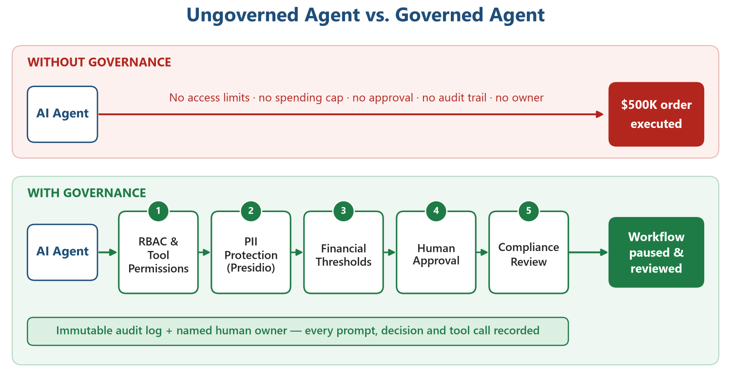
Figure: Without governance, one bad decision turns into a $500K order. With governance, the order is checked at every step and paused for a human to review.
Final Thoughts
Agentic AI is a big step forward. Companies move from getting insights to getting things done automatically. If you build in auditing, clear logging and tight access controls from day one, you can use autonomous AI safely, and compliance becomes an advantage instead of a hurdle.
Ready to build secure, production-ready AI agents for your business?
Get in touch with the team at Optimum Data Analytics to see how our Enterprise Connector for Multi-Agent Systems can help you connect and govern AI at scale.
References and Further Reading
If you want to read more, these are good places to start.
1. NIST. Artificial Intelligence Risk Management Framework (AI RMF 1.0), NIST AI 100-1, January 2023. A widely used guide to managing AI risk.
2. OWASP Gen AI Security Project. LLM06:2025 Excessive Agency, OWASP Top 10 for LLM Applications 2025. Explains what goes wrong when an AI system is given too much freedom to act.
3. Infocom Media Development Authority (IMDA), Singapore. Model AI Governance Framework for Agentic AI, 2026. Guidance written specifically for AI agents, covering controls, logging and human accountability.
4. European Union. EU AI Act, Article 14: Human Oversight. Sets out what human oversight of high-risk AI systems should look like.
5. Presidio. Open-source PII detection and anonymization, GitHub. A tool for finding and masking personal data before it reaches an AI model.